
sharing the journey of Relationship, Embodiment, and Awakened Living
sharing the journey of Relationship, Embodiment, and Awakened Living

Life isn't about how to survive the storm
but how to dance in the rain.
I once asked my old Apache friend and teacher, Stalking Wolf, why he would not be cold in the winter or hot in the summer. His answer was, "I am both, but I am not bothered by them."
"Why?" I asked.
He looked for a long time at me, trying to decide, I feel, if I was ready to receive his answer, to accept what he was about tell me. Then he said, "Because they are real."
Tom Brown Jr., The Search
What if each nitty gritty task is perfection itself and you keep missing it because you’re looking for something else?
It’s like washing the dishes. If you focus on getting the dishes done so that your kitchen will be clean, you miss everything that happens between dirty and clean. The warmth of the water, the pop of the bubbles, the movements of your hand. You miss the life that happens in the middle zone between now and what you think your life should be like. And when you miss those moments because you’d rather be doing something else, you are missing your own life…
Even when you arrive at being [someone you consider important], your life might not be any better if you haven’t learned to be awake, alive, now. So take this moment for what it is. It’s just as easy to be miserable when you are someone special as when you are no one in particular… You might as well learn how to pay attention now...
Whatever it offers, the reality of your day-to-day life has to be better than the self-inflicted misery you are creating through the stories you are telling yourself. It has to be better than the nightly binges and throwing yourself into the cycle of self-loathing and promises to stop eating so much. Come back. Break the trance… Wake up to the riot of life all around you every second.
The singer Pearl Bailey said, “People see God every day; they just don’t recognize Him.” What if every day was a chance to see a new version of God? What if what you needed was right in front of you and you were not recognizing it?
You already have everything you need to be content. Your real work… is to do whatever it takes to realize that. And then it won’t matter if you’re someone special or no one in particular because you’ll be fully alive in every moment — which is, I imagine, all you ever wanted [in the first place].
Geneen Roth, Women, Food and God
G.I. Gurdjieff was a spiritual teacher who led a community in France in the 1920's. In this community was a man no one else could stand. Everyone said he was rude, abusive, and lazy. He barely bathed. He did not do his share of the work. And he frequently created more work by leaving messes behind him.
One morning, despised and avoided by everyone else in the group, he finally packed his bags and left. When Gurdjieff heard the news, he took off after him. He finally caught up with the man, begged him to return. In fact, he not only waived the man's fee but offered to pay him.
Of course, once everyone found out, they were shocked and outraged. Gurdjieff told his followers that this man was a crucial member of the community, "grist for the mill."
"You need him to learn compassion, "said Gurdjieff. "Without him, you have nothing to forgive."
adapted from H.C. Touchon and other sources
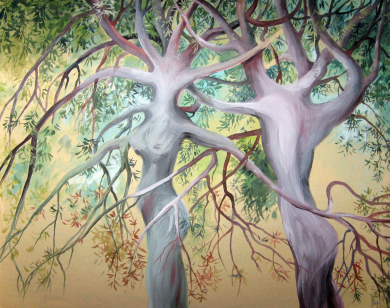 Love is a temporary madness. It erupts like an earthquake and then subsides. And when it subsides you have to make a decision. You have to work out whether your roots have become so entwined together that it is inconceivable that you should ever part. Because this is what love is. Love is not breathlessness, it is not excitement, it is not the promulgation of promises of eternal passion. That is just being in love which any of us can convince ourselves we are. Love itself is what is left over when being in love has burned away, and this is both an art and a fortunate accident. Your mother and I had it, we had roots that grew towards each other underground, and when all the pretty blossom had fallen from our branches we found that we were one tree and not two.
Captain Corelli's Mandolin
What transpires in the course of many years of loving… is a gradual but progressive enlargement of the self… The more we love, the more blurred becomes the distinction between the self and the world. We become identified with the world. And as our ego boundaries become blurred and thinned, we begin more and more to experience the same sort of feeling of ecstasy that we have when our ego boundaries partially collapse and we "fall in love." Only, instead of having merged temporarily and unrealistically with a single beloved object, we have merged realistically and more permanently with much of the world.
A "mystical union" with the entire world may be established. The feeling of ecstasy or bliss associated with this union, while perhaps more gentle and less dramatic than that associated with falling in love, is nonetheless much more stable and lasting and ultimately satisfying. It is the difference between the peak experience, typified by falling in love, and what Abraham Maslow has referred to as the “plateau experience.” The heights are not suddenly glimpsed and lost again; they are attained forever.
M. Scott Peck, The Road Less Traveled
An internal relationship must be worked on and maintained just like an external relationship. This is a lifelong process. If you decide to learn to care for yourself, to live your life in compassion, you will be required to practice that until you die. And that’s good news! When you fall in love with someone, you don’t say, “oh, no, how long am I going to have to love this person?” When we’re in love, we love to love that person, and we hope it will last forever.
Cheri Huber, There is Nothing Wrong with You
 After the rains the hills were splendid. Still brown from the summer sun, and now all the green things would return. It had rained all night and the beauty was indescribable. The sky was still cloudy and in the air was the smell of sumac, sage and eucalyptus. It was splendid to be among them, and a strange stillness possessed you.
Unlike the sea far below, the hills were completely still, and your mind too was washed empty. All through the night it pursued you, love’s stillness, and when you woke, long before the sun, it was still there in your heart, with its incredible joy, for no reason whatsoever. It was there, causeless, and it would be there, all through the day, without your ever asking or inviting it to stay.
adapted from Krishnamurti, Meditations 1969